Definition
When glucose is broken down, its energy is captured as ATP, the cell’s energy currency, at several points along the way. This note adds up that ATP for one glucose molecule. It also explains why books give different totals and how much of the energy in glucose is kept rather than lost as heat.
1. What the three stages hand over
Glucose is broken down in three stages, and each stage hands over two kinds of product to the final count. One is ATP made directly, when an enzyme moves a phosphate group from a fuel molecule onto ADP (substrate level phosphorylation). The other is the hydrogen carriers NADH and FADH2. They take hydrogen and its electrons to the electron transport chain, a set of proteins inside the mitochondrion where most ATP is made.
Glycolysis splits glucose into 2 pyruvate and gives a net 2 ATP and 2 NADH (Glycolysis). Converting the 2 pyruvate into 2 acetyl CoA gives 2 more NADH. The Krebs cycle, also called the citric acid cycle or TCA cycle, then turns twice, once for each acetyl CoA. These two turns give 2 ATP, 6 NADH and 2 FADH2 (Krebs Cycle). Altogether, one glucose provides 4 ATP by substrate level phosphorylation, 10 NADH and 2 FADH2.
2. The balance sheet
The carriers become ATP only when they pass their hydrogen to the electron transport chain. There the electrons flow to oxygen, and their energy drives ATP synthesis, a process called oxidative phosphorylation (Oxidative Phosphorylation). On average each NADH yields about 2.5 ATP and each FADH2 about 1.5 ATP, because FADH2 hands its electrons to the chain further along.
| Source | Reaction | Net ATP |
|---|---|---|
| Substrate level phosphorylation | Glycolysis | 2 |
| 2 NADH | Glycolysis | 5 |
| 2 NADH | Pyruvate to acetyl CoA | 5 |
| Substrate level phosphorylation | Krebs cycle | 2 |
| 6 NADH | Krebs cycle | 15 |
| 2 FADH2 | Krebs cycle | 3 |
| Total | 32 |
Each carrier row is a simple multiplication. The 2 NADH of glycolysis and the 2 NADH of the pyruvate step each give 2 times 2.5, or 5 ATP. The 6 NADH of the Krebs cycle give 15 ATP, and the 2 FADH2 give 2 times 1.5, or 3 ATP. So the 10 NADH and 2 FADH2 together make 28 ATP in the electron transport chain.
The word net in the table matters. The complete breakdown of glucose forms 34 ATP in all, because glycolysis makes 4, the Krebs cycle makes 2 and the electron transport chain makes 28. But glycolysis had to spend 2 ATP at the start to prime glucose with phosphate. So the net yield in skeletal muscle is 32 ATP per glucose. Of these, 4 come from substrate level phosphorylation, 2 net from glycolysis and 2 from the Krebs cycle. The other 28 come from oxidative phosphorylation.
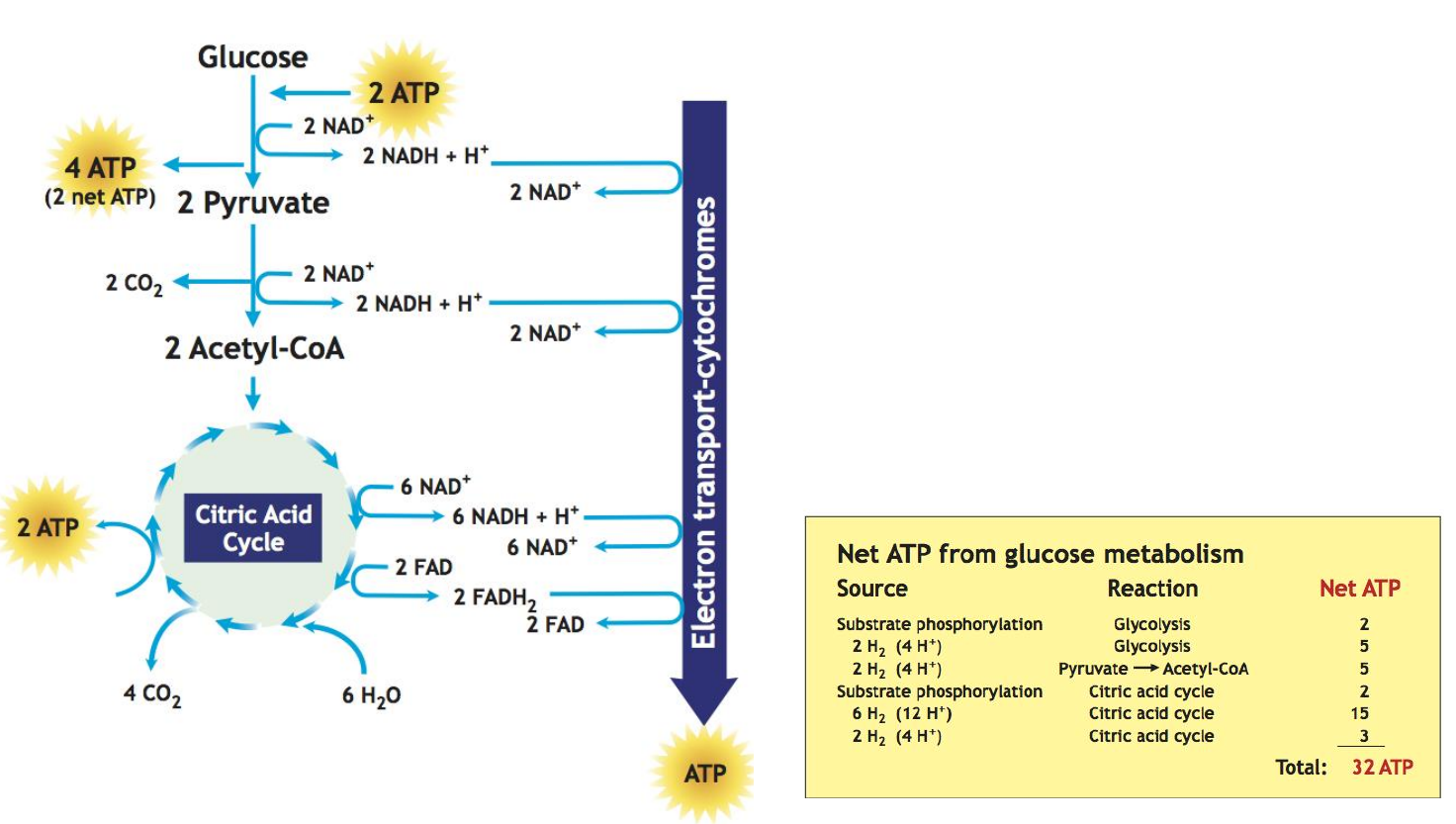
The diagram follows one glucose from top to bottom. Glucose is primed with 2 ATP and split into 2 pyruvate, which yields 4 ATP, labelled 2 net. The 2 pyruvate become 2 acetyl CoA, which feed the citric acid cycle. Along the way carbon leaves as CO2, 2 molecules at the pyruvate step and 4 in the cycle. Every NADH and FADH2 travels right to the tall blue arrow labelled electron transport cytochromes, which ends in ATP. The carriers then return empty as NAD+ and FAD, like delivery vans going back for another load. The yellow table on the right is the balance sheet above. Its rows are written as pairs of hydrogen atoms, so 2 H2 means 2 NADH or, in the last row, 2 FADH2.
3. Why other totals exist
Other books print 36 or 38 ATP because they use older values of 3 ATP per NADH and 2 ATP per FADH2. On that count the 10 NADH give 30 ATP and the 2 FADH2 give 4. Adding the 4 from substrate level phosphorylation gives 38 ATP, a theoretical maximum still printed in many textbooks. The total of 36 ATP is the same older count applied to skeletal muscle. There, the 2 NADH made by glycolysis in the cytosol cannot enter the mitochondrion. A shuttle carries their hydrogen in on FAD instead, so each is worth 2 ATP rather than 3, and 38 becomes 36. The value of 32 uses the measured averages of 2.5 and 1.5, so it is the one to use.
4. With oxygen and without
Without enough oxygen, glucose stops at pyruvate, which becomes lactate so that glycolysis can keep running (Lactate). The yield is then only 2 ATP per glucose. Fully oxidised glucose gives 32 ATP, which is sixteen times as much. So rapid glycolysis on its own delivers about 6 per cent of the ATP that glucose can give, a share often quoted as 5 per cent because it was worked out from the older total of 38.
This means that a muscle short of oxygen must break down glucose about sixteen times faster to make the same ATP. That is why all out efforts drain muscle glycogen, the muscle’s store of glucose, so quickly and cannot last.
5. Efficiency
Efficiency asks how much of the energy in glucose ends up in ATP. Each mole of ATP formed from ADP and inorganic phosphate (Pi) conserves about 7 kcal, or 7.3 kcal more precisely. One mole of glucose holds 686 kcal. So 32 moles of ATP hold 32 times 7.3 kcal, which is about 234 kcal. Dividing 234 kcal by 686 kcal gives a relative efficiency of about 34 per cent.
The other 66 per cent is released as heat. This is the second law of thermodynamics at work, since every energy transfer loses some energy as heat (Energy and Thermodynamics). It is also why the body warms up during exercise. The older counts give other figures, with 263 kcal conserved for 36 ATP and an efficiency of about 40 per cent for 38 ATP. Even 34 per cent is good for a machine, since a steam engine turns only roughly 30 per cent of its fuel into useful work.
Summary
Summary
One glucose hands over 4 ATP made directly, 10 NADH and 2 FADH2 from glycolysis, the pyruvate to acetyl CoA step and two turns of the Krebs cycle. At 2.5 ATP per NADH and 1.5 per FADH2, the carriers give 28 ATP in the electron transport chain. The process forms 34 ATP in all, but glycolysis spent 2 at the start, so the net yield is 32 ATP, with 4 from substrate level phosphorylation and 28 from oxidative phosphorylation. Totals of 36 and 38 ATP come from the older values of 3 ATP per NADH and 2 per FADH2. Without oxygen glucose gives only 2 ATP, one sixteenth of the aerobic yield, so glycogen is used up quickly. The 32 ATP hold about 234 of the 686 kcal in glucose, an efficiency of about 34 per cent, and the rest is released as heat.