Definition
Hard working muscle can break down sugar faster than its mitochondria can finish the job with oxygen. This note follows what the cell does with the leftover hydrogen, and why the result, lactate, is a useful fuel rather than a waste.
1. Glycolysis needs its NAD+ back
Glycolysis is the chain of reactions in the cytosol, the fluid of the cell outside the mitochondria, that splits one glucose into 2 pyruvate (Glycolysis). At step 6 it strips hydrogen from the sugar. A carrier molecule called NAD+ must accept that hydrogen, and it becomes NADH. Without a free NAD+, step 6 cannot happen.
The difficulty is that a cell holds only a small amount of NAD+. Each glucose turns 2 NAD+ into 2 NADH, so the supply soon runs out if nothing empties the NADH again. Glycolysis would then stop, however much glucose was available.
The cell has two ways to unload NADH. With enough oxygen, and mitochondria that can keep up, NADH hands its hydrogen to the respiratory chain in the mitochondria (Oxidative Phosphorylation). When that route cannot keep up, NADH hands its hydrogen to pyruvate instead. This second route is anaerobic or rapid glycolysis, meaning glycolysis that does not use oxygen, and it ends with pyruvate becoming lactate.
2. Pyruvate takes the hydrogen
The transfer is carried out by an enzyme, a protein that speeds up one particular reaction, called lactate dehydrogenase (LDH). It moves the two hydrogens of NADH + H+ onto pyruvate, where H+ is a hydrogen ion. Pyruvate becomes lactate and NADH becomes NAD+ again, pyruvate + NADH + H+ ⇄ lactate + NAD+. The double arrow means the reaction can run both ways, which matters for what happens to lactate later.
For each glucose, 2 pyruvate become 2 lactate and 2 NAD+ return to step 6. Glycolysis can therefore keep running at full speed and keep giving its net 2 ATP per glucose with no oxygen at all. The overall reaction is glucose + 2 ADP + 2 Pi → 2 lactate + 2 ATP + 2 H2O. Here ADP is adenosine diphosphate, Pi is inorganic phosphate and H2O is water. Lactate is a temporary parking place for hydrogen, much like an overdraft that keeps a business trading until the debt is repaid.
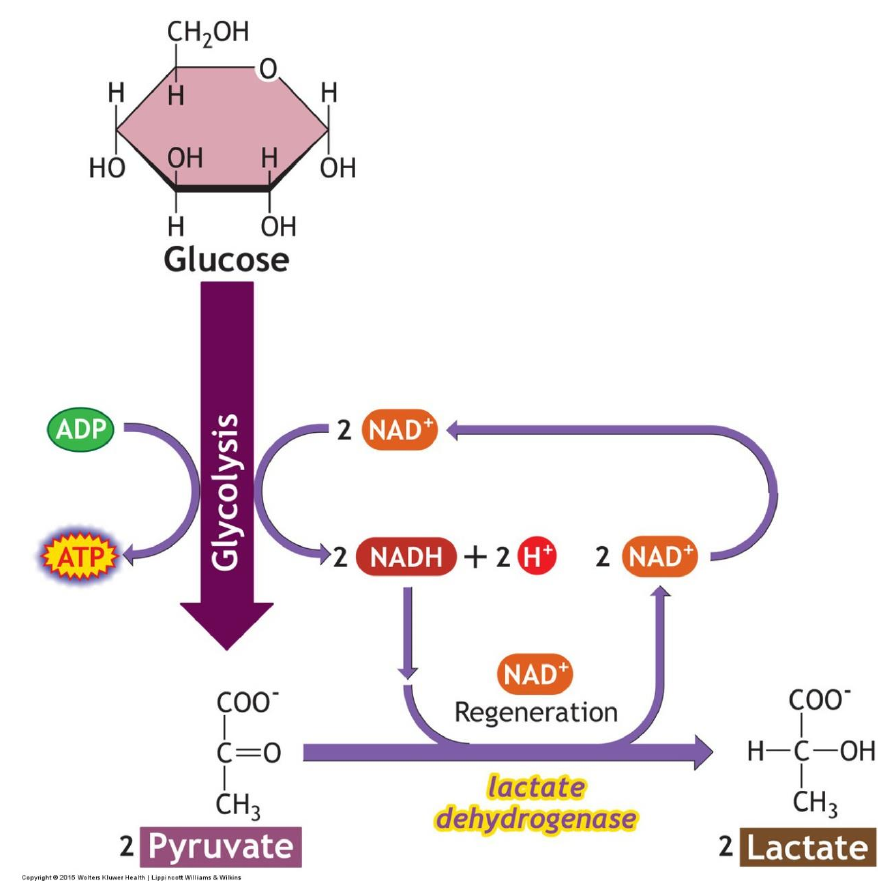
The loop can be followed from the top. Glucose passes down the purple arrow of glycolysis, and on the left ADP becomes ATP. On the right, 2 NAD+ pick up hydrogen and become 2 NADH + 2 H+. At the bottom, lactate dehydrogenase adds that hydrogen to 2 pyruvate, giving 2 lactate. The loop labelled NAD+ Regeneration carries the 2 NAD+ back to the top for the next glucose. That loop is the whole point of the reaction, and lactate is simply where the hydrogen ends up.
3. When lactate accumulates
Some lactate is made all the time, even at rest. Red blood cells, which carry oxygen in the blood (Unloading Oxygen and Carrying Carbon Dioxide – Bohr Effect, 2,3-DPG, Myoglobin and Bicarbonate), have no mitochondria. Glycolysis ending in lactate is their only source of ATP.
In light and moderate exercise, lactate is removed as fast as it is made, so its level in the blood stays low. In intense exercise, glycolysis makes pyruvate and NADH faster than the mitochondria can take them in. More muscle fibres that are rich in glycolytic enzymes are also brought into use. So during intense exercise pyruvate binds hydrogen to form lactate, and lactate builds up in muscle and blood.
The intensity at which blood lactate begins to climb is the lactate threshold (Oxygen Uptake – VO2, VO2max and the Lactate Threshold). Lactate forms whenever glycolysis outruns the mitochondria. This is not the same as a total lack of oxygen, because working muscle can make lactate while still receiving oxygen.
4. Lactic acid or lactate
Lactic acid and lactate are often treated as the same thing, but they differ. Lactic acid forms during anaerobic glycolysis. In the body it at once dissociates, meaning it splits and releases a hydrogen ion (H+). The rest binds a positively charged sodium ion (Na+) or potassium ion (K+) to form an acid salt, lactate.
So the molecule found in the body is lactate. It is the hydrogen ions released alongside it that make muscle and blood more acid. Buffers, chemicals that soak up hydrogen ions, deal with them (Acid–Base Balance in Exercise – Buffers, Ventilation and the Kidney).
5. Where lactate goes
Lactate is not a dead end, because the LDH reaction can run backwards. Lactate leaves the working muscle cell, enters the blood and has two main fates.
- Part is taken up by the heart, by less active muscle fibres and by other tissues. They turn it back into pyruvate with LDH and burn it in their mitochondria through the Krebs Cycle.
- Part is taken up by the liver, which rebuilds it into glucose. The liver stores this glucose as glycogen or releases it into the blood for the muscles to use again.
Building new glucose from smaller molecules such as lactate is called gluconeogenesis (Glycogen and Blood Glucose). The round trip, glucose to lactate in muscle and lactate back to glucose in the liver, is the Cori cycle.
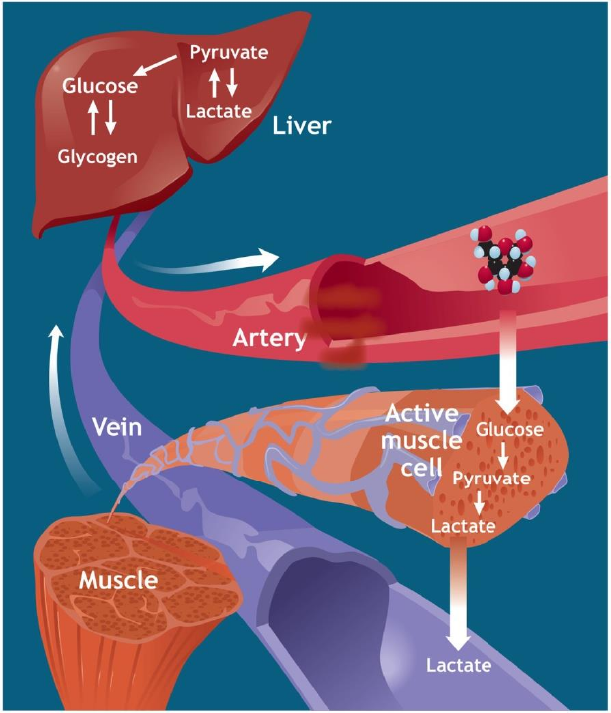
The white arrows trace this cycle. At the lower right, an active muscle cell turns glucose into pyruvate and then lactate. The lactate is carried in the vein up to the liver at the top left, where it becomes pyruvate, then glucose, then perhaps glycogen. The glucose leaves in the artery and returns to the muscle. It works like a recycling service that turns spent fuel back into fresh glucose.
6. Lactate as a fuel
For most of the last two centuries, lactate was seen as a waste. It was first found in sour milk in 1780. It was later thought to form when oxygen runs short, and to be a possible cause of fatigue.
The modern picture is different. Even at rest, blood plasma holds about 1 millimolar of lactate, one thousandth of a mole per litre. Lactate is turned over faster than any other abundant fuel molecule. Tissues all over the body constantly release it, and others constantly take it up. It is either turned back into sugar in the liver and kidneys or fully oxidised to carbon dioxide and water in mitochondria. During heavy exercise lactate can become the heart's main fuel, ahead of fatty acids.
Recent work in heart muscle has also changed the view of how lactate reaches the mitochondria. The usual route has four steps, and a newly proposed shortcut lets lactate enter the mitochondrion before it is turned into pyruvate (Thome and Arany, 2026).
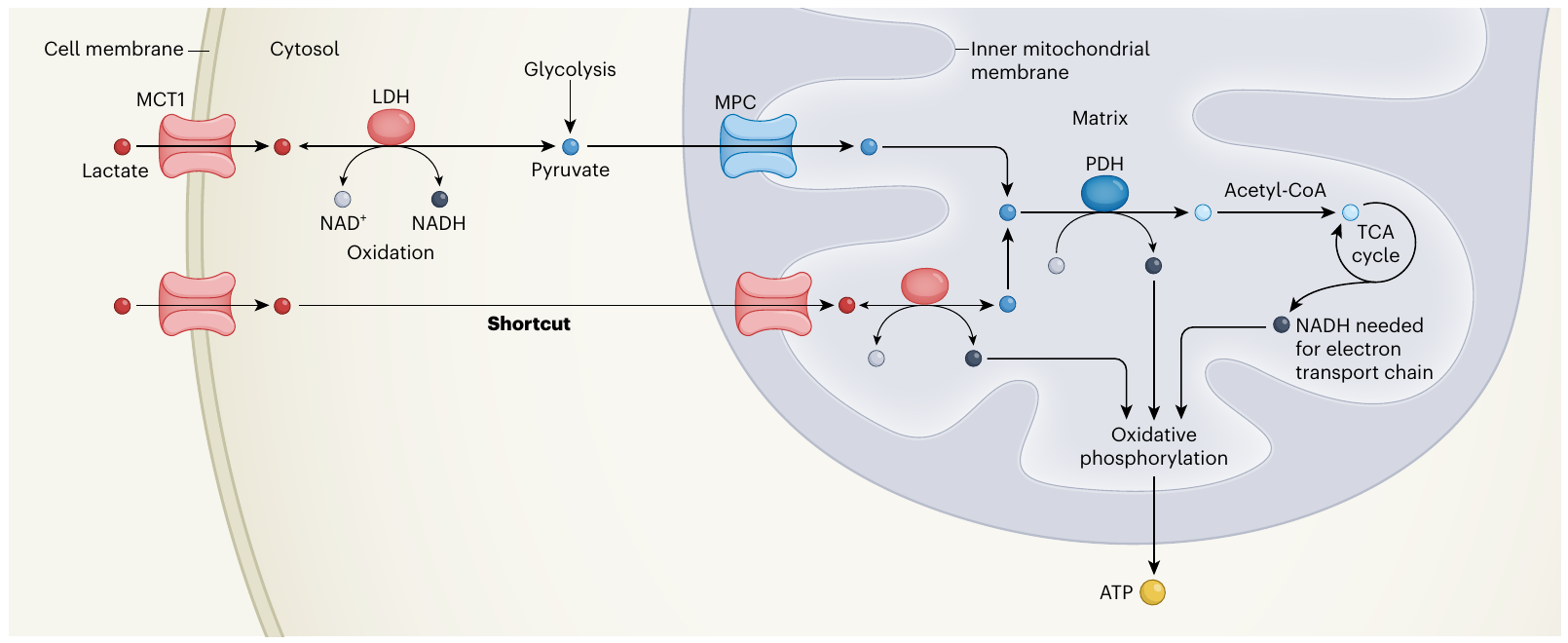
Here a heart muscle cell has its cell membrane on the left and a mitochondrion on the right. In the upper, usual route, lactate enters through a transporter protein called MCT1 (monocarboxylate transporter 1). In the cytosol, LDH turns it into pyruvate while NAD+ becomes NADH. Pyruvate, which glycolysis also makes, crosses the inner mitochondrial membrane through the mitochondrial pyruvate carrier (MPC). In the matrix, the mitochondrion’s inner space, the enzyme pyruvate dehydrogenase (PDH) turns it into acetyl CoA. Acetyl CoA feeds the Krebs cycle, labelled TCA cycle, and the NADH formed drives oxidative phosphorylation to make ATP. In the lower route, labelled Shortcut, lactate passes through a second MCT1 in the inner membrane and becomes pyruvate inside the matrix. This shortcut may matter when the heart is under stress, and it is still debated.
Summary
Summary
Glycolysis needs a free NAD+ at step 6 to accept hydrogen, and a cell holds so little that glycolysis would stop if its NADH were never unloaded. When the mitochondria cannot take that hydrogen fast enough, as in intense exercise, lactate dehydrogenase (LDH) passes it to pyruvate, which becomes lactate. This returns 2 NAD+ per glucose, so glycolysis keeps making ATP without oxygen, overall glucose + 2 ADP + 2 Pi → 2 lactate + 2 ATP + 2 H2O. Lactate therefore builds up whenever glycolysis outruns the mitochondria, and the intensity at which blood lactate starts to climb is the lactate threshold. Lactic acid at once releases a hydrogen ion, so the molecule in the body is the salt lactate and the hydrogen ions are what make muscle acid. Because LDH works both ways, lactate is burned by the heart and less active muscle or rebuilt into glucose by the liver through gluconeogenesis, a loop called the Cori cycle. Far from being a waste, lactate circulates at about 1 millimolar even at rest and can become the heart’s main fuel in heavy exercise. It enters cells through MCT1, becomes pyruvate by LDH, enters mitochondria through MPC and becomes acetyl CoA by PDH, and in the heart it may also slip into mitochondria directly through MCT1.
References
Thome T, Arany Z (2026). Lactate takes a shortcut into mitochondria. Nature, News and Views. https://doi.org/10.1038/d41586-026-03261-2