Definition
The IASP (International Association for the Study of Pain) defines pain as an unpleasant sensory and emotional experience associated with potential or actual tissue damage, or described in terms of such damage. Pain is therefore not just a sensation but also an emotional experience, and actual tissue damage is not required for it to be felt.
Nociception versus pain
Nociception is the process of transmitting a painful stimulus: the neural activity that carries the signal from the site of injury up toward the central nervous system. It must not be confused with pain itself, because "Pain is in the Brain": the unpleasant sensory and emotional experience only arises once the brain processes the incoming signal. Transmission of the stimulus and the experience of pain are two distinct steps.
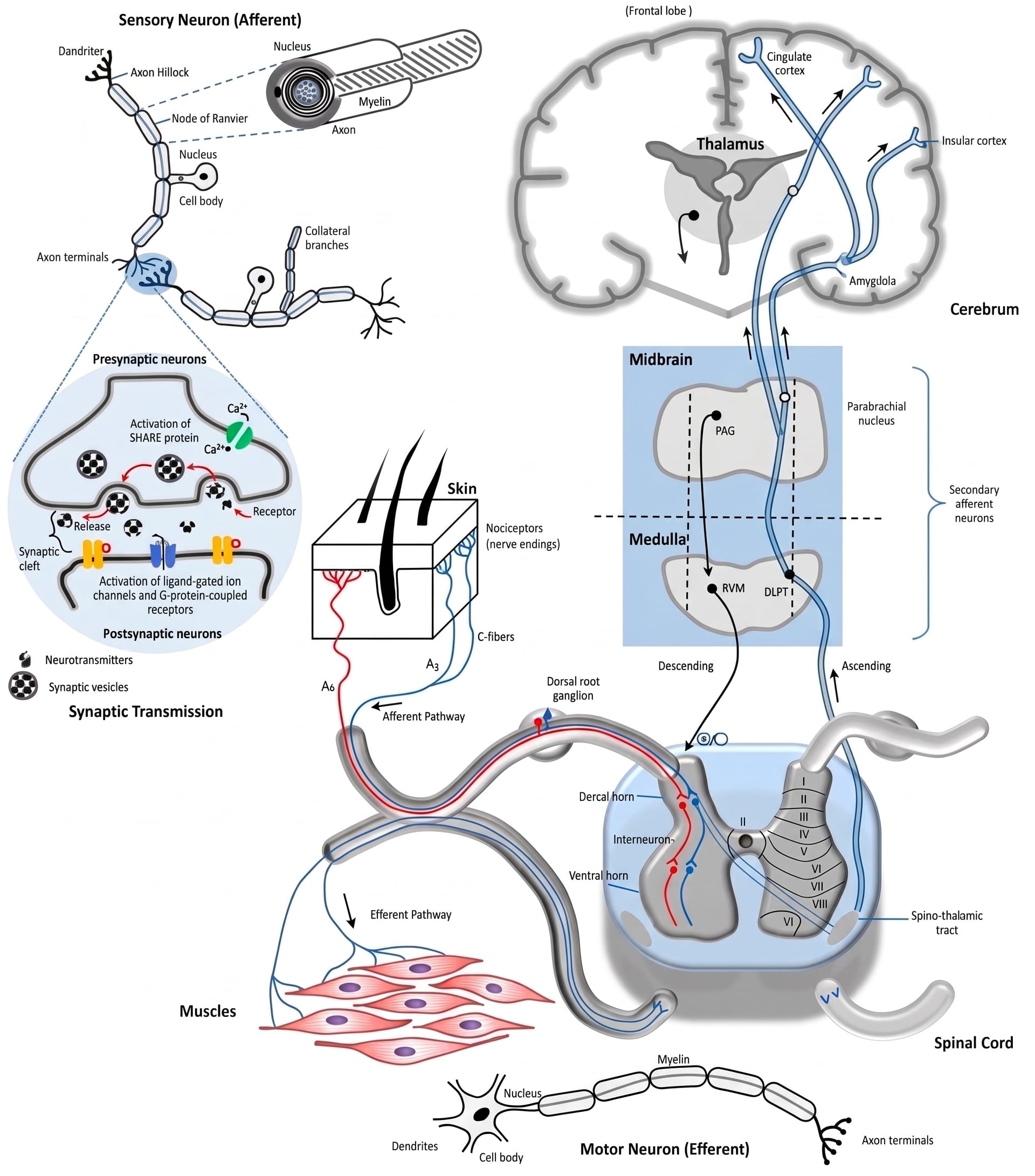
The figure shows the whole route in one view: a noxious stimulus at the skin activates a sensory (afferent) neuron, whose cell body sits in the dorsal root ganglion; its signal is relayed across a synapse (shown magnified) into the dorsal horn of the spinal cord, from where second order neurons ascend to the thalamus and on to the somatosensory cortex, which is where the pain is actually experienced. The diagram also includes the descending pathways from midbrain and medulla back down to the spinal cord, which modulate the incoming pain signal, and a motor (efferent) neuron leaving the cord toward muscle.
Acute somatic pain
Acute pain is divided into somatic and visceral. Acute somatic pain arises either from superficial structures, such as the skin, or from deep structures, such as connective tissue and bone. It is well localised, plays a protective role and promotes healing: the pain warns us of tissue damage and forces us to guard and rest the injured part, so it is protected from further harm while it repairs.
Acute visceral pain
Acute visceral pain arises from the internal organs, triggered by distension of an organ, as in colic, or by inflammation, as in appendicitis. Unlike somatic pain, it is poorly localised. The reason is that very few dorsal horn neurons in the spinal cord are dedicated to visceral pain alone: visceral and cutaneous afferents converge onto the same cells, so few are dedicated to visceral pain alone, which is why visceral pain is poorly localised and can be referred to the skin and the pain can even be felt at a somatic site (the basis of Referred pain).
Chronic pain
Chronic pain is long term, debilitating pain accompanied by altered pain perception. The examples given are rheumatoid arthritis, a chronic autoimmune inflammation of the joints that produces persistent joint pain, and phantom limb pain, in which a person who has lost a limb continues to feel it and experiences pain as if it were coming from the missing limb. Because C fibres carry slow, dull, persistent pain, chronic pain conditions are thought to involve ongoing overactivity of C fibre input, consistent with the altered pain perception and sensitisation described in Pain Experience and Descending Modulation.
Summary
Summary
Pain is an unpleasant sensory and emotional experience associated with potential or actual tissue damage, or described in terms of such damage. Nociception, the process of transmitting a painful stimulus, is distinct from pain itself, which is experienced in the brain. Acute somatic pain, superficial or deep, is well localised, protective and promotes healing; acute visceral pain arises from distension or inflammation of internal organs and is poorly localised; chronic pain is long term and debilitating, with altered pain perception, as in rheumatoid arthritis and phantom limb pain.