Definition
The receptive field of a sensory neuron is the area over which a stimulus produces a change in the rate of action potential firing. Receptive fields are what set the spatial accuracy of somatic sensation, and two point discrimination is the test that measures that accuracy.
1. Definition and spatial accuracy
A stimulus inside a neuron’s receptive field changes its firing rate; one outside it does not. The field therefore determines the spatial accuracy of sensory stimuli: the nervous system localises a touch by knowing which afferent, and so which patch of skin, is firing. Field size differs across body regions, and this difference underlies regional differences in acuity.
2. Overlapping fields and summation at the second order neuron
Receptive fields are not separate tiles: those of neighbouring primary afferents overlap, so one point of skin lies within several fields. These afferents converge centrally, with summation at the second order neuron (see summation), whose receptive field includes all the overlapping primary fields that feed it and so is larger than any single one.
3. Field size versus afferent density
There is an inverse relationship between the size of the receptive field and the number of afferents supplying the area. Densely innervated regions such as the fingertips, lips and toes are served by many afferents, each with a small field, giving fine spatial accuracy. Sparsely innervated regions such as the forearm and the back are served by few afferents with large fields, so spatial accuracy there is coarse. Hence the class illustration: an itch on the back is hard to localise well enough to scratch, precisely because the back has few afferents with large receptive fields, so the active afferent only narrows the stimulus down to a broad patch of skin.
4. Two point discrimination
Two point discrimination is the minimum distance required to perceive two simultaneously applied stimuli as distinct, classically tested with calipers. The threshold tracks field size and innervation density: it is finest at the fingertips (about 2 mm) and coarsest on the arm, back and leg (up to roughly 40 mm). The mechanism rests on the pattern of activity across afferents with overlapping fields. Two points close together within one field generate a single focus of activity and are felt as one; only when the points are far enough apart to fall in different fields does the population show two separate foci of firing, which the nervous system reads as two stimuli.
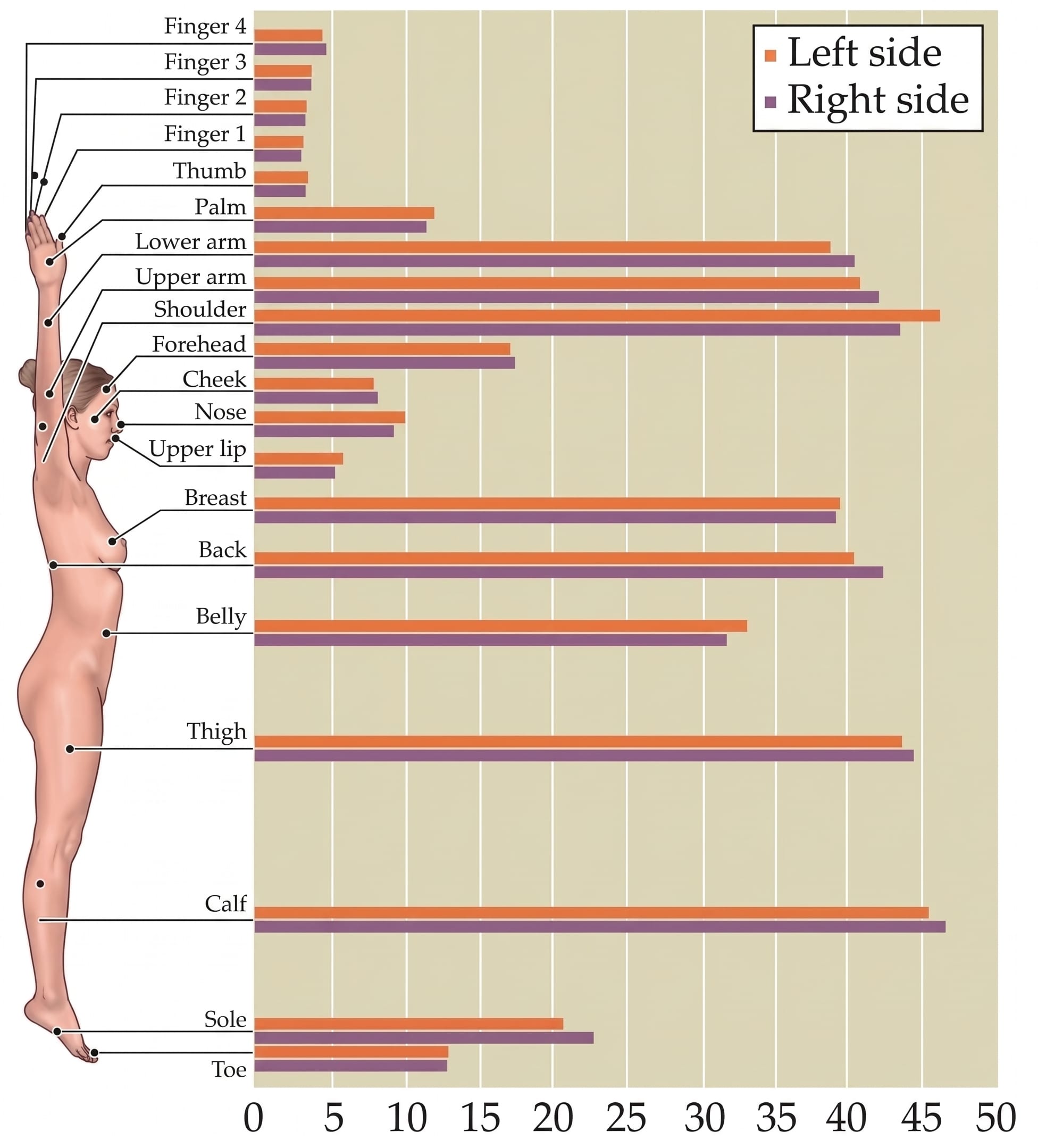
This figure plots the left and right sides of the body separately, but the small differences between sides fall within the margin of error of the measurement and carry no real meaning; the message to keep is the regional gradient, from about 2 mm at the fingertips to about 40 mm on the trunk and limbs.
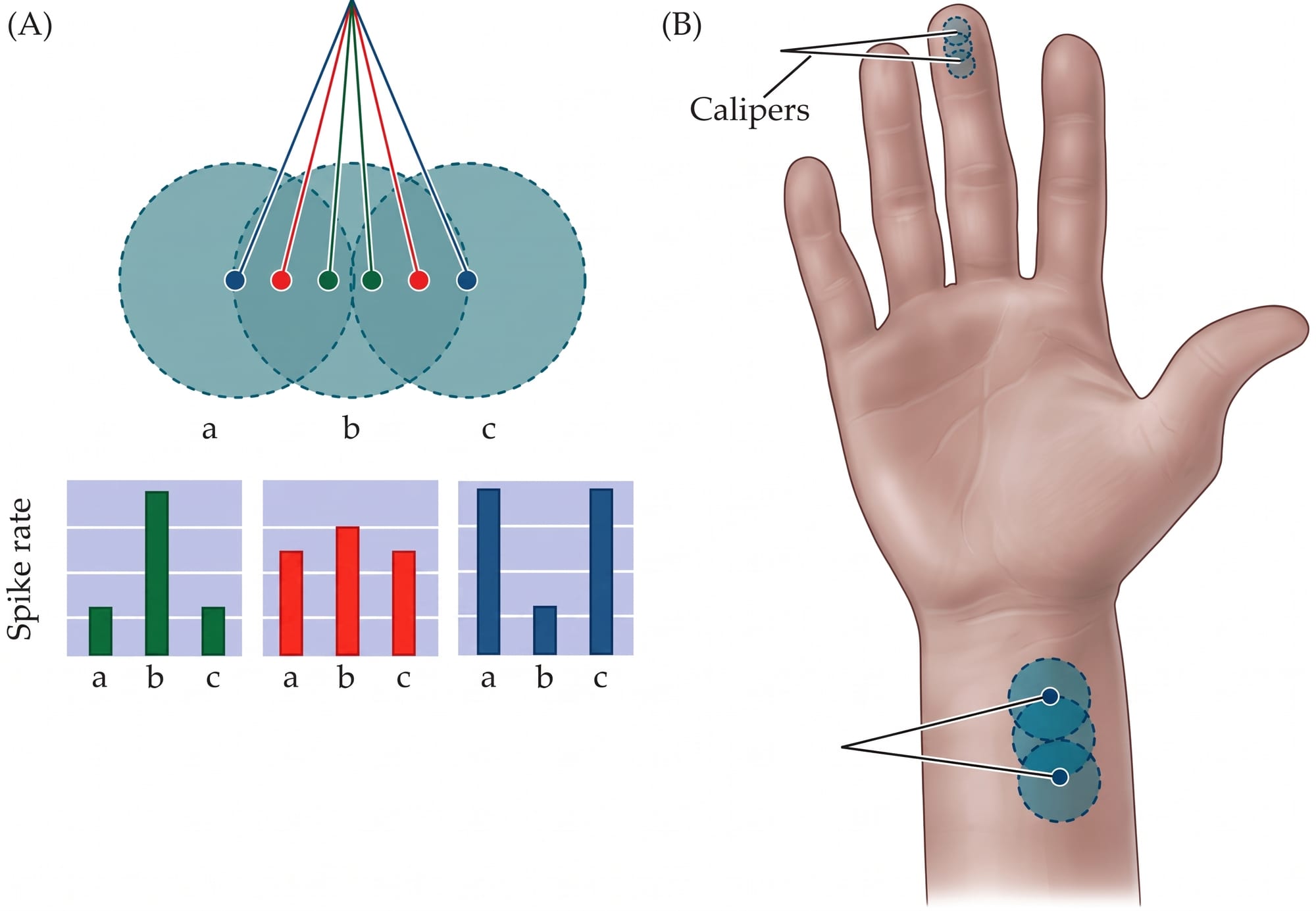
The second figure shows why two point discrimination depends on receptive field size. In panel A, three afferents with overlapping fields (a, b, c) are stimulated by two caliper points: when the points are close together inside one field, only the central afferent fires strongly and the population shows a single peak of activity, felt as one touch; as the points separate, the neighbouring afferents join in, until the points fall in different fields and the firing profile splits into two distinct peaks, felt as two touches. Panel B shows the anatomical consequence: the fingertip is covered in tiny densely packed fields, so tips 2 mm apart already land in different fields, whereas the forearm has large broadly overlapping fields, so the calipers must be opened to about 40 mm before two separate peaks emerge.
Summary
Summary
A receptive field is the area over which a stimulus changes a neuron’s action potential firing rate, and it determines spatial accuracy. Primary afferent fields overlap and converge, with summation at the second order neuron, whose field is the union of the overlapping primary fields. Field size is inversely related to afferent density: small fields and dense innervation give fine acuity, large fields and sparse innervation give coarse acuity. Two point discrimination, the minimum distance at which two stimuli are perceived as distinct, measures this directly: about 2 mm on the fingertips versus up to 40 mm on the limbs and trunk, because two points can only be told apart once they fall in different receptive fields and produce two separate foci of activity.