Definition
A postsynaptic potential (PSP) is the local, graded change in membrane voltage produced on the postsynaptic cell when neurotransmitter opens ion channels there (see Neurotransmitter Receptors). Unlike an action potential, it is not a signal in itself: it is a vote, excitatory or inhibitory, that only matters once votes are added up at the axon hillock.
1. EPSP: excitatory postsynaptic potential
-
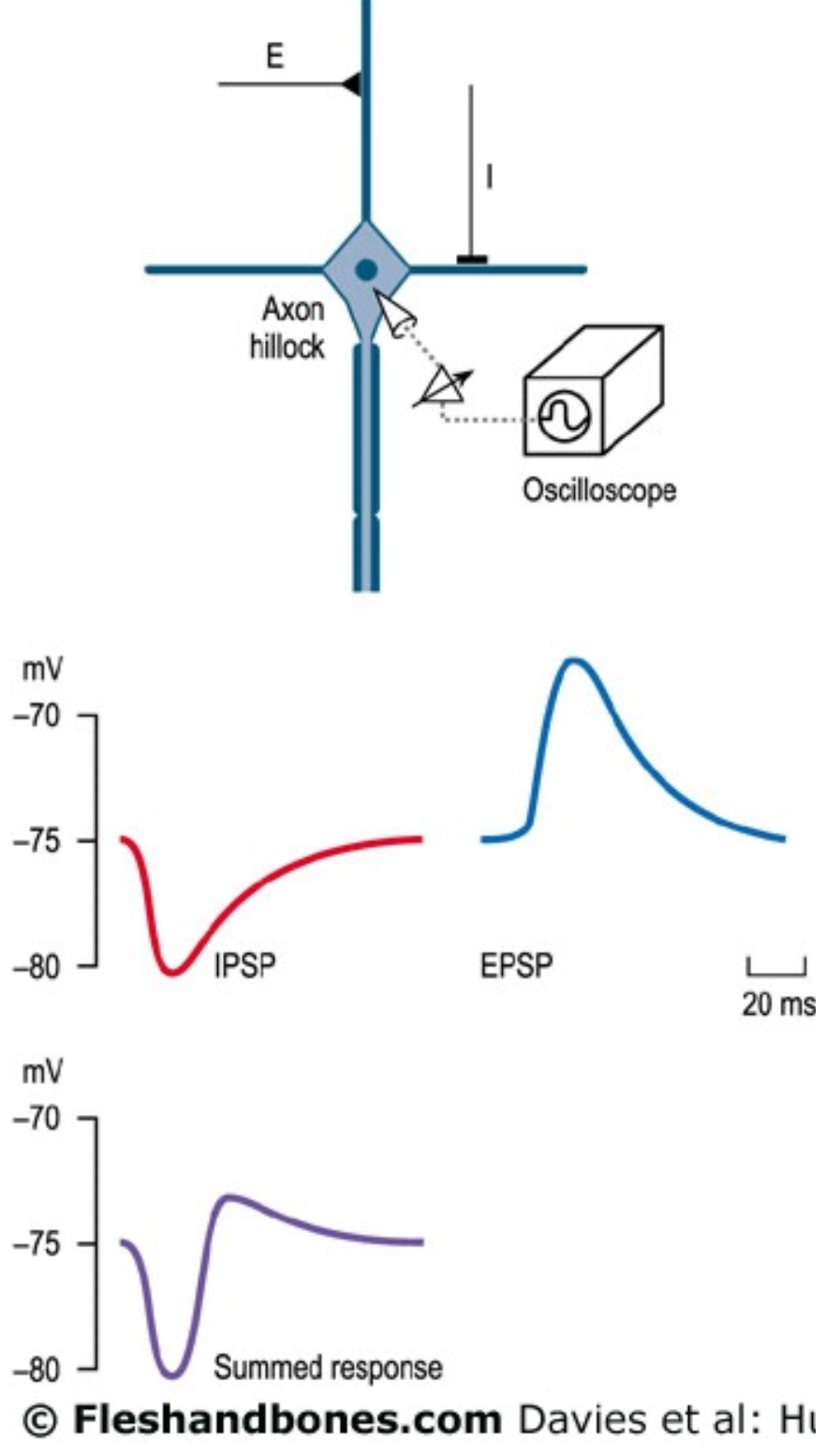
Excitatory neurotransmitters produce depolarisation of the postsynaptic membrane: ligand gated channels open, Na⁺ flows in, and the membrane moves toward threshold.
-
An EPSP may favour an action potential, but is not in itself one:
- No propagation: it is a local potential that decays with distance from the synapse.
- Graded responses obtainable: its size is proportional to the amount of transmitter released and the number of channels opened. It has no threshold and no all or none behaviour, which is exactly why EPSPs can be added together.
2. IPSP: inhibitory postsynaptic potential
-
Inhibitory neurotransmitters produce hyperpolarisation of the postsynaptic membrane (typically Cl⁻ influx or K⁺ efflux, via GABA or glycine receptors). GABA opens Cl⁻ channels, and Cl⁻ is concentrated outside the cell, so it flows in and makes the inside more negative (see Membrane Potential).
-
An IPSP makes it more difficult to trigger an action potential, because the membrane is pushed further away from threshold. The excitatory input then has to work harder to reach it.
3. Summation at the axon hillock
- The axon hillock is the integration site: it carries the highest density of voltage gated Na⁺ channels, so it has the lowest threshold and is where the action potential is actually born.
- Each synapse is far from the hillock and each single PSP is small, so one EPSP alone almost never fires the cell. The hillock reads the algebraic sum of all incoming EPSPs and IPSPs at that instant.
- If the summed depolarisation reaches threshold → action potential. If not, nothing happens.
4. Spatial and temporal summation
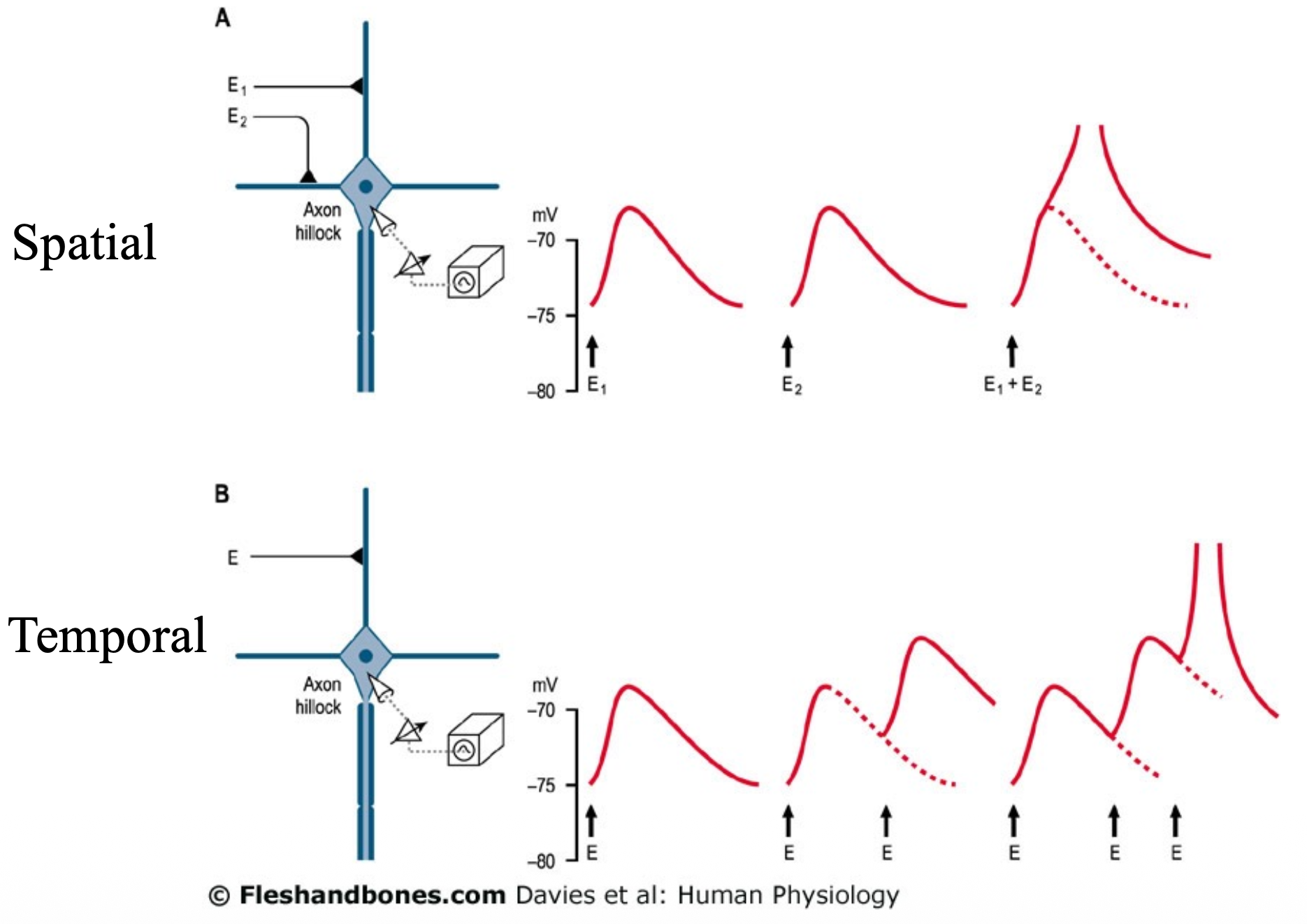
- Spatial summation: two or more presynaptic inputs at different sites (E1, E2) fire at the same time. Each alone is too small, but their currents flow to the hillock simultaneously and add, reaching threshold together.
- Temporal summation: one input fires repeatedly in rapid succession. A single PSP lasts tens of milliseconds, so if the next EPSP arrives before the previous one has decayed, the second rides on the tail of the first and the depolarisation builds up step by step until threshold.
Summary
Summary
PSPs are local, graded, non propagated potentials: EPSPs depolarise and favour firing, IPSPs hyperpolarise and oppose it. Because they are graded and long lasting relative to an action potential, they can summate at the axon hillock, spatially (several inputs at once) or temporally (one input firing repeatedly), and only when their sum crosses threshold does the postsynaptic neuron fire.