Immunology (Dr Louise Horrigan)
Lysozyme, present in tears, saliva and mucus, contributes to innate defence by
Lysozyme is an enzyme in tears, saliva and mucus that breaks down bacterial cell walls, and with the skin it is one of the barriers at the front of innate defence. Punching pores in membranes is done by complement’s membrane attack complex and by perforin, while coating microbes to aid phagocytosis is opsonisation and neutralising toxins is a job of antibodies. See Immune System Overview – Functions and the Two Branches > 2. Two branches, one system.
Regarding the secondary lymphoid organs, which of the following is INCORRECT?
The spleen filters the blood, whereas lymph nodes filter lymph, the tissue fluid draining back towards the blood, and are where lymphocytes meet antigen. The tonsils and adenoids are examples of the mucosal immune system, the lymphoid tissue under the moist linings of the gut, airways and urogenital tract through which most microbes enter. See Cells and tissues of the immune system > 2. Where immune cells gather and work the secondary (peripheral) lymphoid organs.
Phagocytosis begins with chemotaxis, in which the phagocyte
Chemotaxis is movement up a chemical gradient: the phagocyte crawls towards rising concentrations of attractants, such as microbial products and some cytokines, until the microbe adheres to it, which is the recognition step. Extending pseudopods and sealing the microbe in a phagosome are the ingestion phases that follow, and releasing chromatin as a trap is NETosis, a fate of some neutrophils rather than a phase of phagocytosis. See Innate Immunity – Pathogen Recognition and Phagocytosis > 3. The seven phases.
Which of the following is an example of the innate branch instructing the adaptive branch?
A T cell receptor cannot recognise a free microbe, so an innate antigen-presenting cell such as a dendritic cell phagocytoses it and displays its fragments on MHC to T cells, which is how the innate branch instructs the adaptive branch. Antibodies recruiting phagocytes and helper T cells boosting macrophages run the other way, with the adaptive branch using innate tools, and phagocytosis of a C3b-coated microbe involves no lymphocyte at all. See T Cells and Antigen Presentation > 1. T cells need an introduction.
Which antibody isotype features in allergic responses and in defence against helminth infection?
IgE features in allergic responses and is important in defence against helminths (parasitic worms), alongside mast cells and eosinophils. IgA is the antibody abundant in secretions such as saliva, IgG makes up 70 to 75% of circulating immunoglobulin and alone crosses the placenta, and IgD, under 1% of serum Ig, serves with IgM as a B cell receptor. See B Cells and Antibodies > 4. The five isotypes.
The secondary antibody response is faster than the primary response mainly because
Clonal expansion in the primary response leaves memory B cells that far outnumber the few naive B cells that began it, and because they are already selected and ready, there is no long wait for a rare matching cell to find the antigen and multiply. Naive B cells, never before exposed to the antigen, are what mount the slower primary response, and innate cells such as macrophages have no memory. See Immunological Memory – Primary and Secondary Responses > 1. Why the second time is different.
NSAIDs such as ibuprofen ease the pain and swelling of an acute injury by
NSAIDs (non-steroidal anti-inflammatory drugs) such as ibuprofen block the production of prostaglandins, the lipid mediators that cause pain, fever and vasodilation, and are meant for short-term topical or oral use. Vasoconstriction and reduced metabolism and oxidative stress are effects of cryotherapy (ice), and histamine, stored in mast cells, is a different mediator. See Inflammation – Acute, Chronic and CRP > 3. Helpful or harmful to treat or not.
Exercise immunology began in 1902, when __________ was observed in marathon runners.
In 1902 a temporary rise in the white blood cell count, called transient leukocytosis, was observed in marathon runners, and many studies since have shown that exercise influences the differentiation, trafficking and function of immune cells. Lymphocytopenia, a fall in circulating lymphocytes, is the opposite change and belongs to the open window after very intense or prolonged exercise. See Exercise and Infection Risk – J-Shaped Curve and Open Window > 1. Why exercise immunology exists.
During exercise, raised cardiac output and shear stress cause demargination, in which
A higher cardiac output raises shear stress, the drag of flowing blood on vessel walls, so leukocytes parked against the walls of vascular pools, perhaps in the spleen, lung, liver and active muscles, are washed into the circulating blood. Squeezing between endothelial cells is diapedesis, the last step in leaving the blood, and the rise in adhesion molecules on lymphocytes follows catecholamines acting on their β2-adrenergic receptors. See Mechanisms of Exercise-Induced Immune Changes > 2. The big picture.
IL-6 produced under chronic high-intensity exercise tends to be pro-inflammatory, unlike the IL-6 released in a single bout, because it
IL-6 under chronic high-intensity exercise tends to be pro-inflammatory because it uses a different signalling mechanism: brief muscle pulses signal in a way that does not switch on TNF-α and IL-1, whereas IL-6 that stays high signals in a way that amplifies inflammation. Raising IL-10 and IL-1ra and lowering TNF-α are the anti-inflammatory effects of the short-lived muscle pulses of a single bout. See IL-6 in Exercise > 5. The IL-6 paradox.
Cardiovascular System (Prof. Tony Wheatley)
In relation to the equation MAP = CO x TPR, which statement is correct:
The pressure driving blood round the systemic circuit is MAP minus right atrial pressure, and because RAP is about 0 mmHg, MAP alone appears in the equation. MAP is diastolic plus a third of the pulse pressure, not the simple average, and TPR = MAP / CO. See Circulation Overview – Circuits, Vessels and the MAP Equation > 4. The three features and the one equation.
If the right ventricle ejects slightly more blood than the left for a few beats, which of the following follows:
Because the circuits are in series, the extra right ventricular output fills the left ventricle more, raising its EDV and, by Starling’s law, its stroke volume, so the two outputs are matched beat by beat. This needs no nerve or hormone, and a rise in contractility would instead move the heart onto a different curve. See Pressure–Volume Loop, Starling’s Law and Contractility > 3. Starling’s law of the heart.
In aortic stenosis, the murmur is heard:
A stenosis murmur sounds while its valve should be open, and the aortic valve is open during ejection, so the murmur is systolic and peaks at mid-systole. A murmur lasting throughout systole indicates mitral incompetence, an early diastolic one aortic incompetence, and a low-pitched mid-diastolic one mitral stenosis. See The Cardiac Cycle – Phases, Pressures, Volumes and Heart Sounds > 8. Murmurs.
On the LV pressure–volume loop, at which point is the mitral valve open and the ventricle filling?
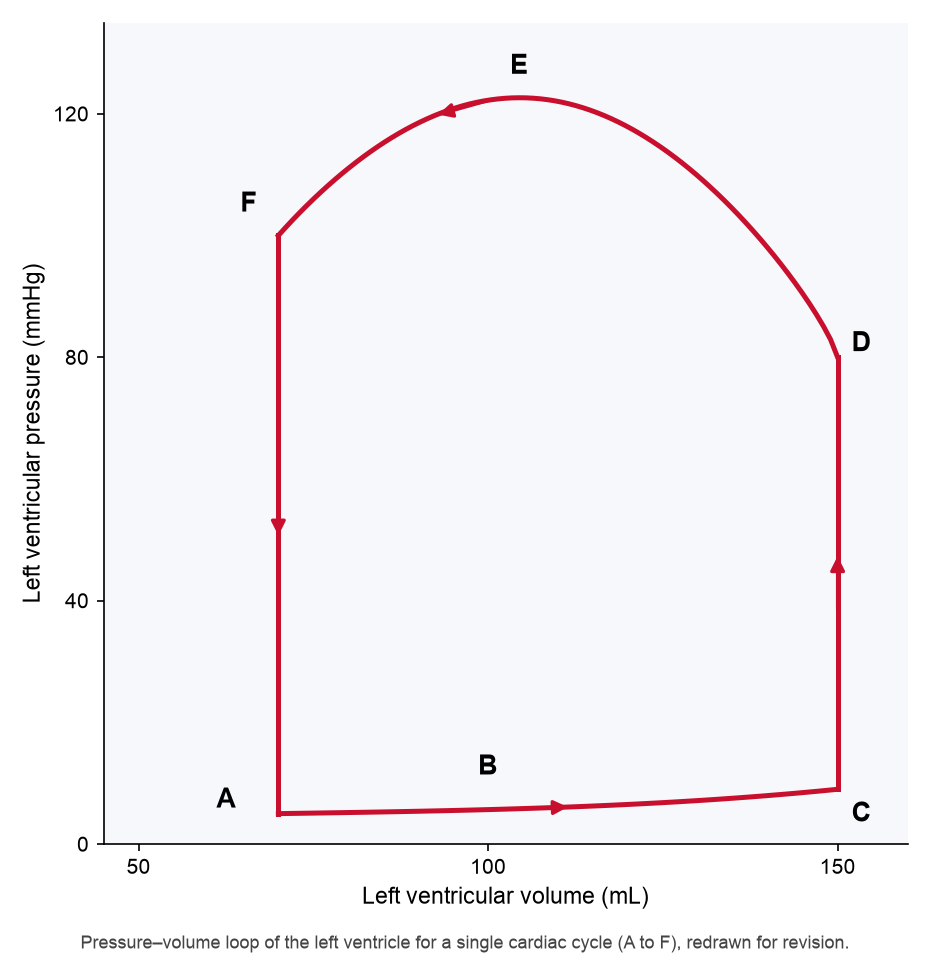
B lies along the bottom of the loop, between the mitral valve opening at A and closing at C, so the ventricle is filling. At D, E and F the mitral valve is shut: D and E are on the ejection limb, and F is aortic valve closure, the start of isovolumetric relaxation. See Pressure–Volume Loop, Starling’s Law and Contractility > 2. The pressure–volume loop.
In relation to phosphorylation of troponin I by protein kinase A, which statement is correct:
Phosphorylated troponin I makes troponin C hold Ca2+ less tightly, so calcium lets go sooner and relaxation is faster. The extra Ca2+ entry comes from PKA phosphorylating the L-type channel itself, and SR uptake is sped up, not slowed, through phospholamban. See Excitation–Contraction Coupling – Calcium Cycle and Sympathetic Stimulation > 4. Sympathetic stimulation more force, faster, and faster relaxation.
Cardiac muscle cannot be tetanised because:
The plateau keeps the cell refractory for 200–400 ms while contraction lasts only 200–250 ms, so a new contraction cannot start until the last is over and contractions never fuse. Gap junctions explain all-or-none contraction, not why beats cannot summate. See Cardiac Action Potential – Resting Potential, Phases and Refractory Period > 4. Why the plateau is long.
On an ECG recorded at 25 mm/s, the R waves of a regular rhythm are 20 small squares apart. The heart rate is approximately:
Five small squares make one large square, so 20 small squares are 4 large squares, and heart rate = 300 / 4 = 75 beats/min. A rate of 100 beats/min would need 3 large squares and 60 beats/min would need 5. See The ECG – Conduction, Leads and the Hexaxial System > 6. Reading the paper calibration, intervals and heart rate.
In relation to active (metabolic) hyperaemia, which statement is correct:
Falling O2 and accumulating metabolites dilate the arterioles, and the increased flow then washes the metabolites out, so resistance rises and flow falls back towards normal. No single metabolite has been identified; CO2, H+, lactate and adenosine are all candidates. See Vascular Resistance – Pressure Profile, Radius and Control of Arterioles > 7. Local metabolic control.
On suddenly lying down after standing, which of the following occurs:
Lying down removes the extra 50 mmHg in the legs, so venous return and CO rise, and the carotid sinus, now level with the heart, senses a higher pressure. The reflex therefore slows the heart and dilates vessels; a fall in venous return and CO is what happens on standing up. See Arterial Blood Pressure – Measurement, Normal Values and the Baroreflex > 5. The baroreceptor reflex.
During exercise, as core temperature rises, vasodilation in glabrous skin is caused by:
Glabrous skin widens passively: its sympathetic nerves fire less, so its many AVAs relax. Active sympathetic cholinergic vasodilation, with ACh helped by NO, is the mechanism in hairy (non-glabrous) skin. See Coronary and Cutaneous Blood Flow > 5. Heat, cold and exercise.
Respiratory System (Dr Daniel O’Toole)
In vigorous exercise, expiration becomes active through contraction of the
In hard exercise elastic recoil cannot empty the lungs fast enough, so the abdominal muscles and internal intercostals pull the ribs down and push the abdominal contents up against the diaphragm. The diaphragm and external intercostals are the inspiratory muscles, which relax during expiration. See The Lungs and the Breathing Pump – Alveoli, Airways, Muscles, Surfactant and the Valsalva Manoeuvre > 6. Breathing out.
Restrictive lung disease, such as pulmonary fibrosis, typically shows
Stiff lungs cannot fill, so FVC is small, but the airways are open and the little air they hold leaves fast, which gives a normal or high ratio (about 90 per cent in the fibrosis example). A low FEV1/FVC is the obstructive pattern, as seen in asthma. See Lung Volumes and Capacities – Spirometry, FEV1 and FVC > 4. Narrow airways or stiff lungs obstructive versus restrictive disease.
Diffusion of a gas between alveolar air and blood is driven by differences in its
A gas always diffuses from higher to lower partial pressure, whatever other gases are present. Percentage alone does not drive diffusion: air compressed to twice the pressure is still 20.9 per cent oxygen, but its PO2 doubles. See The Respiratory Gases – Composition of Air, Partial Pressures and Exchange across the Alveolar Membrane > 2. Each gas pushes on its own partial pressure.
The flat upper part of the oxygen dissociation curve
The flat top is a safety margin: haemoglobin is still about 90 per cent saturated at a PO2 of 60 mmHg, which protects loading at altitude. Releasing a lot of oxygen for a small fall in PO2 is the job of the steep middle part, where the tissues sit. See Oxygen in the Blood – Dissolved Oxygen, Haemoglobin and the Dissociation Curve > 4. The Oxygen Dissociation Curve and What Its Shape Does.
The central chemoreceptors detect a rise in arterial PCO2 by responding to
CO2 crosses easily into the cerebrospinal fluid and reacts with water to form carbonic acid, and the central receptors respond to the hydrogen ions it releases. They do not respond to a fall in oxygen, which raises ventilation only through the peripheral chemoreceptors. See Control of Breathing – Brainstem Centres, Chemoreceptors and the Three Phases of Exercise Ventilation > 4. The sensors chemoreceptors.
Above the ventilatory threshold, ventilation rises faster than VO2 because
Above the threshold the muscles make lactate anaerobically, and bicarbonate soaks up its hydrogen ions, releasing extra CO2 that must be breathed off. Core temperature acting on the central chemoreceptors explains only the slow drift in ventilation in prolonged exercise in the heat. See Control of Breathing – Brainstem Centres, Chemoreceptors and the Three Phases of Exercise Ventilation > 8. Ventilation against work the ventilatory threshold.
In intense exercise the breathing muscles compete with the limb muscles for blood because they
The breathing and limb muscles are side branches fed from the same arteries, so they share one cardiac output and compete for oxygen and blood flow, most of all in elite athletes. Ventilation reaches only 60 to 85 per cent of MVV at VO2max, and the oxygen cost of breathing climbs steeply rather than falling at high ventilations. See Limits to Ventilation – Work of Breathing, Breathing Reserve, Exercise-Induced Hypoxaemia, Smoking and Cold > 2. Competition for blood between the breathing muscles and the limbs.
Over weeks at high altitude the heart remodels with
Low oxygen narrows the lung’s small arteries, causing pulmonary hypertension. The right ventricle pumps against this higher pressure, so it grows larger and thicker, while the septum thickens and the left ventricle shrinks. See Altitude – Less Oxygen, Acclimatisation, Performance and Altitude Training > 4. The first weeks acclimatisation.
The human cathelicidin LL-37
LL-37 punches pores right through bacterial membranes, and it also signals to receptors on other cells, helping to call in immune cells. Splitting beta-1,4 links in peptidoglycan is the job of lysozyme, while hepcidin, made mostly by the liver, and lactoferrin starve bacteria of iron. See The Lung’s First Line of Defence – Nose, Cilia, Mucus and Antimicrobial Peptides > 5. Molecules that attack microbes antimicrobial peptides, lysozyme and lactoferrin.
M2 macrophages are switched on by
The anti-inflammatory M2 repair state is switched on by IL-4, IL-13, IL-10, TGF-beta, glucocorticoids and adenosine, signals that the fight is ending. Interferon-gamma, LPS, TNF-alpha and GM-CSF switch on the pro-inflammatory M1 state, and IL-1 beta, IL-6, IL-8 and nitric oxide are M1 products. See Lung Immune Cells – Toll-like Receptors, Macrophages and Neutrophils > 4. The macrophage two forms.
Training and Exercise Response (Dr Nicole Burns)
Slow-twitch fibres with a high capacity to generate ATP aerobically contain large quantities of which of the following?
The lecture states that slow-twitch fibres with a high capacity to generate ATP aerobically contain large quantities of myoglobin. Haemoglobin carries O₂ in the blood. Phosphocreatine and glycolytic enzymes are anaerobic substrates and enzymes, and they increase with sprint–power training. See Training & Detraining, slide 13 (Muscle Fiber Type and Size).
In the lecture’s scheme of how aerobic training increases O₂ delivery, increased myocardial contractility raises maximum stroke output through an increase in which of the following?
In the scheme, increased myocardial contractility raises the ejection fraction, which combines with a larger end-diastolic volume to raise maximum stroke output. End-diastolic volume rises through greater venous return, ventricular compliance and internal ventricular dimensions, not through contractility. See Training & Detraining, slide 14 (Aerobic Training Increases Oxygen Delivery to Active Muscles).
The %HRmax method of setting training intensity establishes a level of exercise stress that overloads which of the following?
The lecture distinguishes the two approaches: the %HRmax method sets a level of exercise stress that overloads the central circulation. The lactate-threshold method instead relies on the blood lactate–exercise intensity relationship, which reflects lactate accumulating from anaerobic metabolism. See Training & Detraining, slide 25 (Training Intensity: Train at the Lactate Threshold).
According to the lecture, excessive training intensity and abrupt increases in training volume lead to which of the following?
The lecture calls this ‘overtraining’: excessive training intensity and abrupt increases in training volume increase injury risk to bones, joints and muscles. Higher intensity above threshold does improve VO₂max when volume is controlled, but the lecture presents excessive intensity and abrupt volume increases as a risk, not as the route to the greatest gains. See Training & Detraining, slide 26 (Is Strenuous Training More Effective?).
Within the first 1–2 weeks of detraining, the fall in stroke volume and VO₂max results from a decrease in which of the following?
In the detraining timeline, plasma volume falls within 1–2 weeks, which reduces stroke volume and VO₂max. Capillarisation falls at 2–4 weeks, and left ventricular mass and mitochondrial enzymes fall only after more than 4 weeks. See Training & Detraining, slide 32 (Detraining (Reversal of Adaptations)).
Which of the following best describes what the peripheral chemoreceptors respond to?
The peripheral chemoreceptors (carotid and aortic bodies) respond to changes in O₂, CO₂ and H⁺. The central chemoreceptors are the ones that respond primarily to CO₂-related changes in CNS H⁺. Motor command and sensory feedback are the neural, feed-forward input that matters most at exercise onset. See Integrated Response, slide 8 (What tells the brain to increase ventilation?).
Which of the following best explains why an endurance-trained athlete reaches the ventilatory threshold at a higher VO₂ than an untrained person?
The ventilatory threshold reflects the extra, non-metabolic CO₂ produced when bicarbonate buffers H⁺ from anaerobic metabolism, and because training reduces lactate formation and increases its clearance, H⁺ and this extra CO₂ appear only at a higher VO₂. Lactate itself does not cause the threshold, and buffering H⁺ with bicarbonate adds CO₂ rather than reducing it. See Integrated Response, slide 15 (Ventilation During Non-Steady-Rate PA: Ventilatory Threshold (VT)).
According to the Fick equation, which of the following best explains the higher VO₂max of an endurance-trained athlete compared with an untrained person?
In the Fick equation, VO₂ = Q × (CaO₂ − CvO₂), where Q = HR × SV. Endurance training raises maximal cardiac output through a larger stroke volume while maximal heart rate is maintained, and greater muscle capillary density and mitochondrial O₂ use widen the CaO₂ − CvO₂ difference. A higher maximal heart rate is not a training adaptation, and less O₂ extraction would lower VO₂max rather than raise it. See Integrated Response, slide 16 (VO₂ is constrained by delivery and extraction).
When is the highest VO₂ measured during a graded test accepted as VO₂max?
The highest VO₂ is accepted as VO₂max if two of the four criteria are met: a VO₂ plateau, a final-stage heart rate close to the age-predicted maximum, an RER above 1.10, or an RPE above 17. A plateau is one of these criteria but is not required on its own, and all four need not be met. See Integrated Response, slide 29 (The highest VO₂ value measured during the test is taken as VO₂max if two of the following four criteria have been met).
During submaximal exercise, which of the following best describes the lower ventilatory equivalent for O₂ of an endurance-trained athlete compared with an untrained person?
The ventilatory equivalent for O₂ is minute ventilation divided by O₂ uptake (VE/VO₂), so a lower value means the trained athlete breathes less air for each litre of O₂ consumed, reflecting greater pulmonary ventilation efficiency. Training brings deeper, slower breathing rather than smaller, faster breaths, and more CO₂ exhaled per litre of O₂ would describe a higher RER, not the ventilatory equivalent. See Training & Detraining, slide 16 (Respiratory adaptations to endurance training).